The below video is a research project which expands upon earlier research into the aerodynamics of boomerangs. It applies blade element theory to boomerang aerodynamics, extending derived analytical expressions for time-average drag force and drag torque. It incorporated a meshed ultra wide band tracking system using 16 anchors and 1 radio tag embedded into a test boomerang. This system was used to measure the flight trajectory of the boomerang using the embedded wireless radio. Flight trajectory was simulated using the expressions for lift, rolling-moment, pitching-moment combined with drag force and drag torque. Reasonable agreement was obtained between simulation results and measurement however, further study is required to assess the impact of launch angle and layover of the boomerang throw, which are known to more strongly impact the range ( farthest distance from the launch position )
This below pdf is one of the most advanced studies of boomerang science currently available. It is the work of many hours of study and some very advanced math but it is an excellent description of the aerodynamics of boomerangs, extending upon very extensive work by earlier researchers. The primary authors are described below:
Prasad S. Gudem received the B. Tech degree in Electrical Engineering from the Indian Institute of Technology, Madras, India, in 1988, and the Ph.D. degree in Electrical Engineering from the University of Waterloo, Waterloo, Ontario, Canada, in 1996. He was a Vice President of Engineering at Qualcomm from 2014-2018 and is currently a Adjunct faculty in the Department of Electrical and Computer Engineering, University of California at San Diego, La Jolla, CA, USA. He has 50+ patents and 40+ IEEE publications. He taught several graduate-level classes and co-advised twelve Ph.D. students in RF integrated circuit (IC) design. Dr. Gudem was the recipient of the Graduate Teaching Award in recognition of his outstanding teaching of the ECE265 course sequence, “Communication Circuit Design: I, II, and III”. He is an avid follower of the history of STEM (Science, Technology, Engineering, and Mathematics).
Manuel Schütz received his degree (lic.phil.nat) in physics from the Institute of Applied Physics, University of Bern, Bern, Switzerland in 2003. He is a five-time World Champion in boomerang throwing and holds several world records, among them the long-distance world record (apex at 238m), the current Fast Catch and Trick catch record. Regarded as both a tremendous boomerang athlete as well as a leading edge boomerang designer, Mr.Schütz is one of the leading boomerang experts of all time.Several of his boomerangs are available in our collection, the "Blue Manu", "Yellow Manu" and "Red Manu" boomerangs. Since 2009, he is a mathematics and science teacher at WKS KV Bildung in Bern (Federal Vocational Baccalaureate).
Kyle Holland received a Ph.D degree in electrical engineering from the University of Alberta, Edmonton, AB, Canada in 2016. He is currently a senior engineer in the RFIC Design Group with Qualcomm Technologies, Inc., San Diego, CA, USA. His research interests include the quantum-mechanical simulations of nano-electronic devices, NPath filters, and future electronics.
This is one of my go to for all occasions. I can use it calm wind to heavy wind and the distance is perfect for all the fields I go to. It feels really good to catch, nice and solid. It doesn't take too much power to get awesome flights.
William
09/04/2026
This is going to be interesting, a fully programmable boomerang. It is carbon but it is a soft flimsy carbon so I couldn't use it in heavy wind like the Manu PRO COMPOSITE but I like the programmable aspect.
William
09/04/2026
What a gift!
My 7 year old grandson is having an absolute blast wit his new boomerang. Still working on mastering it but wonderfully intriguing and fun-giving.
Susan Isaacman
08/04/2026
Good in light wind
Consistent return capability. May need rubber bands for high wind days.
Elliott Hamilton
08/03/2026
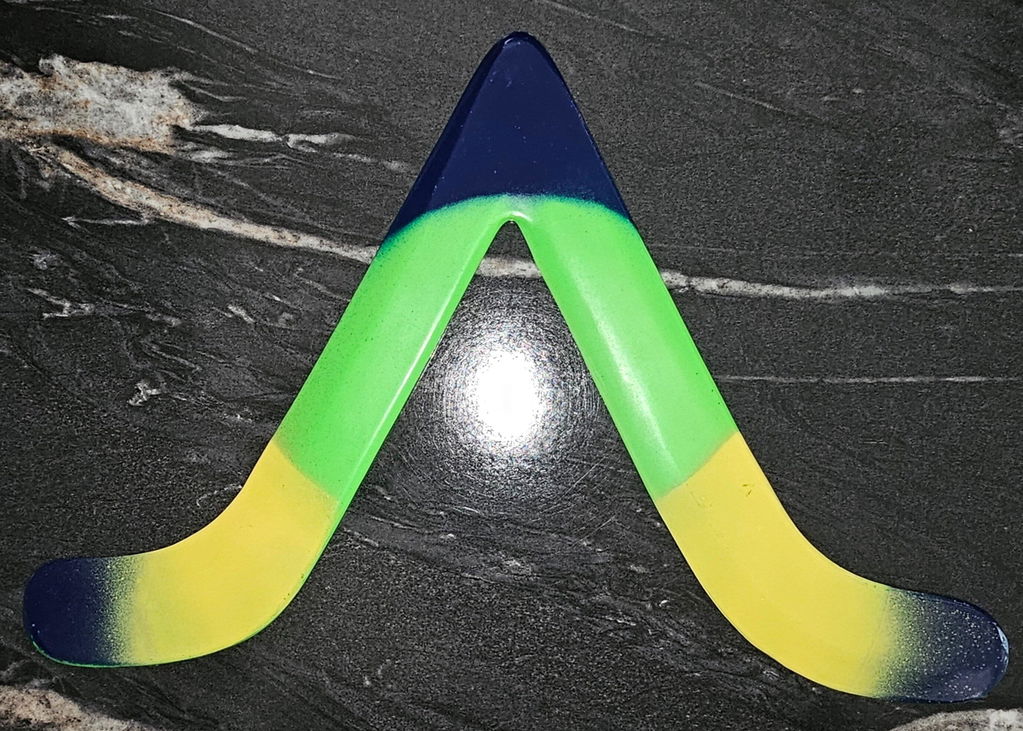
ABS Meteor Boomerang - "A" shaped Plastic boomerang from France
THIS IS AWESOME! it is an ABS Bargan and it goes far and looks cool while it's doing it and it likes the wind. This is my first ABS and I LOVE IT!
William Crawford
07/30/2026
This is my second is 2 for me, I got it as a back up. These go farther then the Trifly, Spin Racer, and Trionyx, it feels like 40m FUN! thank you🙂
William
07/22/2026
ABS Bargan very FUN! this is heavier then the carbon version weighing 48.09g, the carbon is 46.21g. Easy to throw and easy to see, very fun.
William
07/22/2026
My 3rd spin racer, these are awesome. Easy to throw and easy to see, FUN, thank you for everything🙂
William
07/22/2026
This is an ABS S. Marguerite and I LOVE IT! It is easy to see in the grass😁
William
07/22/2026
Awesome, this is an oem replacement for me so IAM familiar with it. Requires a firm throw good for windy days.
William
07/22/2026
Awesome, it seems to go farther than my Trionyx and my Trionyx goes farther than my Trifly, I LOVE IT, THANK YOU!
William
07/06/2026
Awesome! for those windier days, thank you.
William
07/06/2026
Competition Boomerang - Black Barcelona Boomerangs - Carbon infused
Awesome, I LOVE IT! My black Carbon Barcelona weighs 48gr (48.??) and my light blue Barcelona weighs 40grams (40.??). I like my black Carbon Barcelona for heavy winds like when I drop some grass in the air and it blows horizontally instead of diagonally.
William Crawford
06/23/2026
Thanks for everything!
Bliss Lucas
06/22/2026
Seagull Boomerangs - Our highest rated sport boomerang
Axol Cole
06/21/2026
Subscribe
Promotions, new products and sales. Directly to your inbox.
Quick shop
Choosing a selection results in a full page refresh.
This is one of my go to for all occasions. I can use it calm wind to heavy wind and the distance is perfect for all the fields I go to. It feels really good to catch, nice and solid. It doesn't take too much power to get awesome flights.
This is going to be interesting, a fully programmable boomerang. It is carbon but it is a soft flimsy carbon so I couldn't use it in heavy wind like the Manu PRO COMPOSITE but I like the programmable aspect.
This is one of my go to for all occasions. I can use it calm wind to heavy wind and the distance is perfect for all the fields I go to. It feels really good to catch, nice and solid. It doesn't take too much power to get awesome flights.
This is going to be interesting, a fully programmable boomerang. It is carbon but it is a soft flimsy carbon so I couldn't use it in heavy wind like the Manu PRO COMPOSITE but I like the programmable aspect.